
Blog / Process and method
Metadata and taxonomies: how to organise company content
How metadata and taxonomies make company content navigable and useful, with practical examples for service and industrial SMEs.
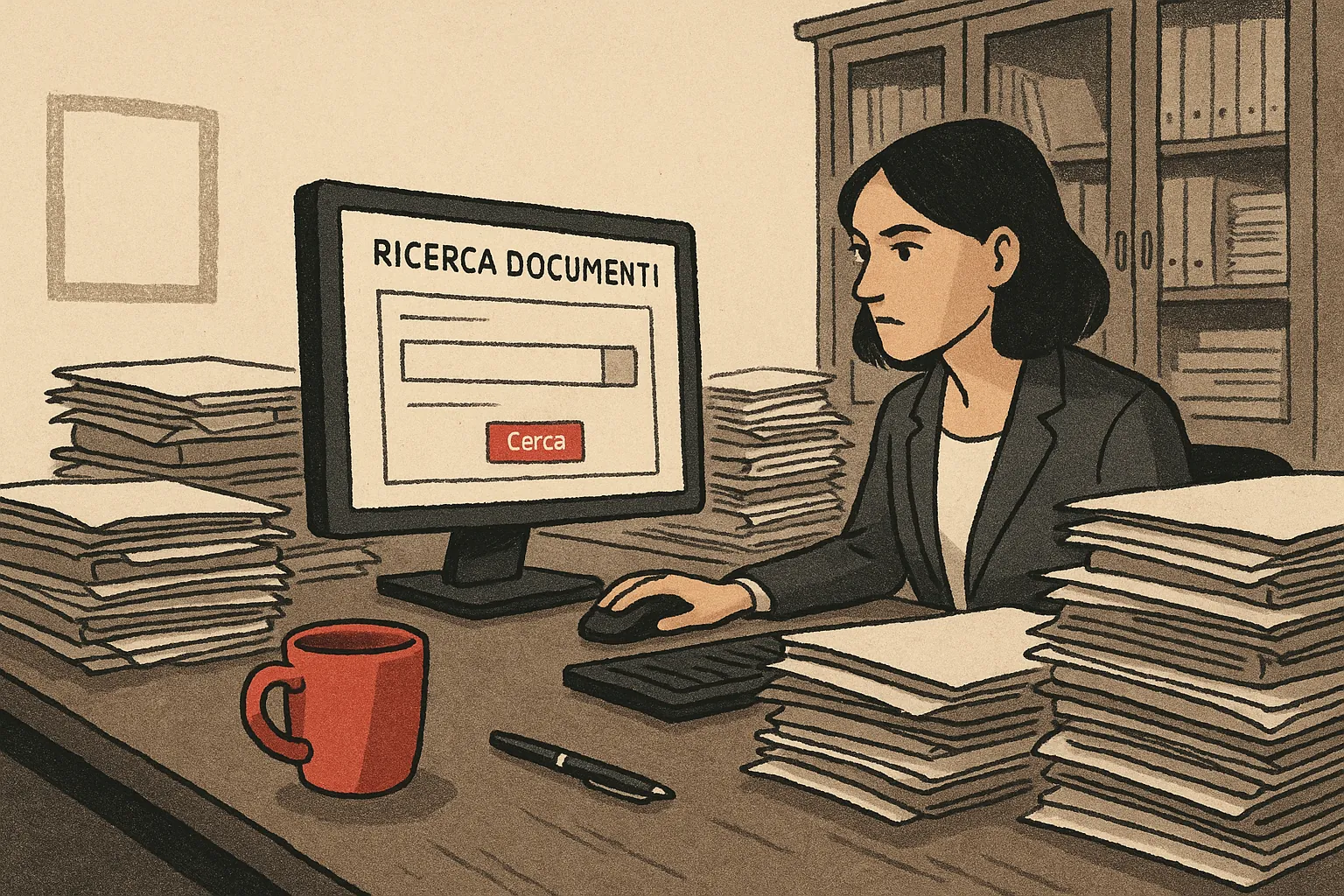
Metadata and taxonomies turn collections of files into systems that are navigable and useful, making search and the automation of business processes easier. Without these structures, content stays scattered and hard to put to use.
Every week someone looks for a document they cannot find, or rewrites from scratch a procedure that already exists. Without metadata and taxonomies, a company's information assets stay invisible and unused.
When documents are just a pile of files
In service companies, a shared archive with no rules quickly turns into a jungle: folders full of versions, different names for the same document, emails saved everywhere. The result is that whoever needs a contract or a technical sheet wastes time, asks around or, worse still, starts over. A concrete example: in a professional firm, the lack of metadata leads to redoing quotes that already exist because nobody knows where the old ones ended up.
What metadata and taxonomies are and why they matter
Metadata is data that describes other data: a date, a client, a type of document. Taxonomies are schemes that order content according to shared categories. Together, they let you search for “all the 2023 contracts for the client Rossi” in a few seconds, instead of scrolling through dozens of folders. Without these tools, even the best management system turns into a store of anonymous files.

Automation and AI agents: structure makes the difference
AI agents with human oversight can automate the classification of documents and suggest where to file them, but only if the rules are clear. If there is no taxonomy, AI cannot guess what matters to the company: the organising work has to come first. A real case: a logistics company only reduced errors in its transport documents after defining key categories and metadata, which made it possible for AI agents to step in automatically.
Where to start: an audit and concrete first steps
The first step is to map what is there: which types of file, which categories are really needed, who uses them. You start with a quick audit, without changing everything at once. You define a few useful metadata fields (client, date, document status) and apply them to new files. Only then do you move on to automation: structure first, then the AI agents that use it. Starting from AI without first putting things in order wastes time and money.
What they are: metadata and taxonomies
Metadata is information that describes other data, such as author or date. Taxonomies are classification schemes that order content according to shared categories. Together, they make company content searchable and manageable.
Frequently asked questions
What are metadata and taxonomies for in a company?
They let you find documents quickly, avoid duplicates and enable reliable automation.
How are they implemented in practice?
You start by mapping the content, choose a few key metadata fields and apply them to new material as it comes in.
Do AI agents work without taxonomies?
No: without a shared structure, AI does not know how to classify or retrieve documents in a useful way.
Is special software needed?
Not always: often it is enough to organise the existing archive better and add metadata where it is needed.
Drafts are produced by the Brainvision OS editorial pipeline and reviewed by a person before publication.
Keep reading
All articles
26 August 2026
Business chatbots: how to really integrate them into your processes
How to integrate business chatbots into real processes: customisation, connectors, skills and the limits you should know. A practical guide for SMEs and service firms.
12 August 2026
AI in business: how to design tools people actually use
Find out how to bring AI into your company's real processes and avoid tools nobody uses. A practical guide for SMEs and professional firms.
7 August 2026
Redesigning processes to bring AI agents into the company
To get a return from agentic AI, processes have to be rethought: here is how to integrate AI agents with human oversight in SMEs.