
Blog / People and work
AI agents and human capital: how work is changing in insurance
How AI agents with human oversight are reshaping insurance processes, making the most of people's skills and cutting repetitive work.

AI agents with human oversight automate repetitive processes in insurance, freeing up time for high-value work and making the most of employees' specialist skills.
Handling claims, policies and customer requests in insurance takes hours of repetitive work. The real challenge is bringing in AI agents without losing service quality or the value of people.
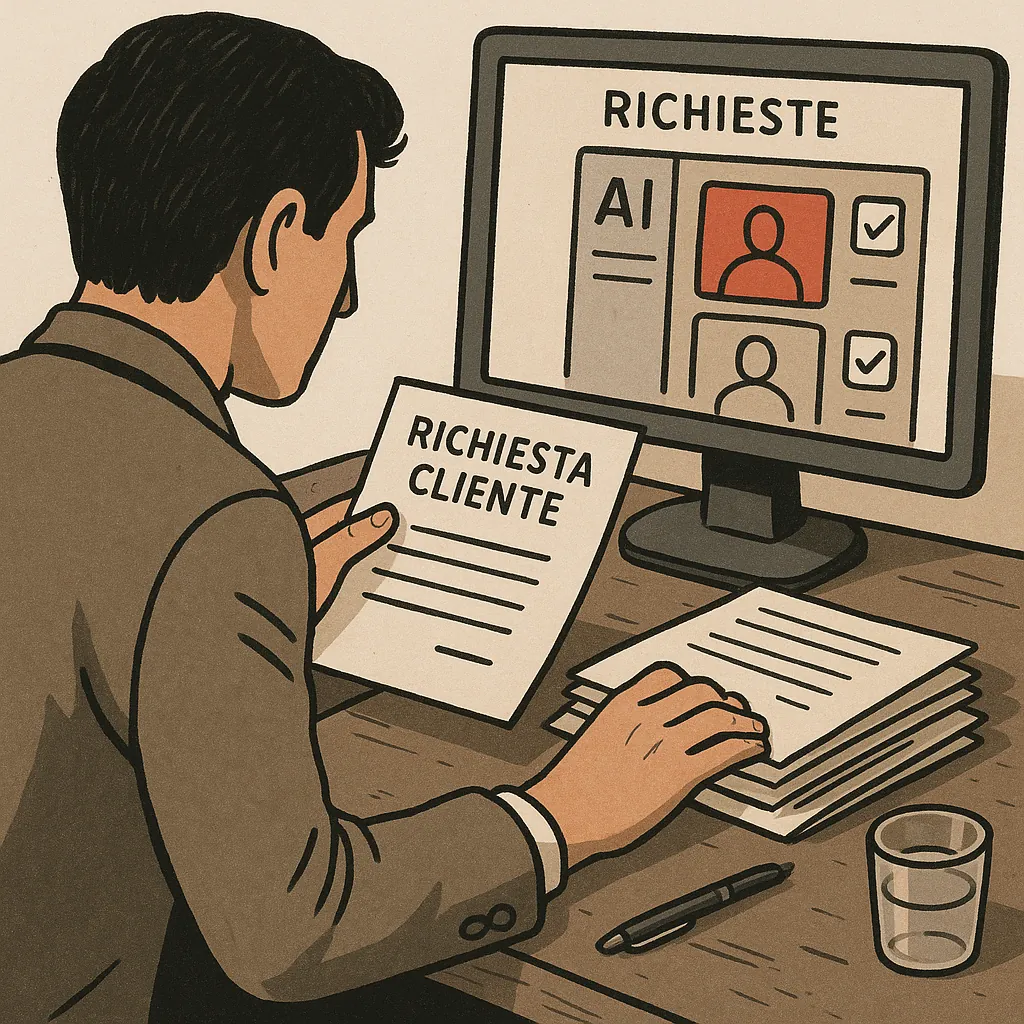
Where the hours go: the case of customer requests
In a mid-sized insurance company, dozens or hundreds of requests arrive every day: claim updates, policy changes, questions about paperwork. These tasks are often handled by operators who have to look up data across several systems, fill in standard replies and forward files. The result is hours of work that add no value, yet are essential to keep the service running. An AI agent with human oversight can filter, classify and pre-fill the replies, leaving colleagues only the cases that call for judgement or a closer look.
How the AI agent fits into the process
The AI agent is trained on the company's real processes: how files are handled, which data matters, which exceptions must be flagged. Integration never happens all at once: you start from one process, measure it before and after, and check whether it actually frees up time and keeps quality intact. The agent never decides on its own: every reply is validated by a person, who can step in or correct it. This approach prevents errors and keeps the service under control.
More time for the work that really matters
When AI agents handle the repetitive tasks, the team can focus on what makes the difference: advice on complex cases, analysis of customer needs, handling exceptions. A concrete example: after an AI agent was introduced for the preliminary assessment of claims, specialists were able to concentrate on the most delicate files, shortening closing times and improving customer satisfaction. Automation does not replace human work, it makes it more effective.
What not to automate: the value of human judgement
Not everything can, or should, be handed to AI agents. Decisions that require regulatory interpretation, empathy towards the customer or complex assessments stay with people. The most common mistake is to think that “adding AI” is enough to solve every problem: what is needed instead is to tell repetitive tasks apart from value-adding ones. That is the only way to avoid losing internal knowledge and to keep customers' trust.
What it is: AI agents with human oversight
Automated systems that carry out repetitive tasks in business processes, where every output is always checked and, if necessary, corrected by a person.
Frequently asked questions
Do AI agents replace staff in insurance?
No, they automate only the repetitive tasks. Staff remain central for decisions and complex cases.
How do you measure the value of an AI agent?
You compare the time, cost and quality of the process before and after the AI agent is introduced.
Is specific training needed to use AI agents?
You need to know the company's processes and be able to validate the agent's results, not advanced technical skills.
What happens if the AI agent gets it wrong?
The error is caught by human oversight, which can correct it and improve the system.
Drafts are produced by the Brainvision OS editorial pipeline and reviewed by a person before publication.
Keep reading
All articles
27 August 2026
Cognitive flexibility and trust in AI
How AI agents with human oversight improve cognitive flexibility and trust in business decisions. Examples for professional firms.
17 August 2026
Training AI agent developers: what it really takes
How to train developers who can build AI agents that are useful in a company. Practical examples and advice for SMEs in Northern Italy.
11 August 2026
Intelligent agents and work: what really changes in a company
AI agents with human oversight are transforming processes in insurance and finance: more efficiency, fewer errors, more value for people's skills.