
Blog / Security and regulation
Identity security for AI agents: what it really takes
How to manage the digital identities of AI agents in a company. The real risks and concrete solutions for security and governance.

Every AI agent that accesses company data or systems is a new digital identity to protect. You need an Identity and Access Management system that also covers non-human agents, with continuous controls and monitoring.
An AI agent working inside business processes accesses data, applications and services with credentials of its own. Left unmanaged, these identities become a weak point: who checks what each agent can actually do?
A new kind of identity to manage
AI agents with human oversight are not ordinary software: they have their own credentials and permissions, and they access systems and data the way a user would. In an SME that automates quotes or reminders, each agent can see sensitive data, send messages and modify documents. If nobody keeps track of these identities and of what they do, the risk is that an error or an unauthorised access goes unnoticed. A concrete example: an agent that handles orders in a cloud management system should have only the permissions strictly necessary, tracked and revocable at any time.
Real risks: what can go wrong
An AI agent left unchecked can become an entry point for unauthorised access. If its credentials are not managed like an employee's, a configuration error can expose confidential data or allow unintended actions. In companies that use cloud systems, an agent with excessive privileges can delete files, send out wrong communications or, worse, be exploited by third parties. The difference from a human? An agent can act much faster and on a large scale.
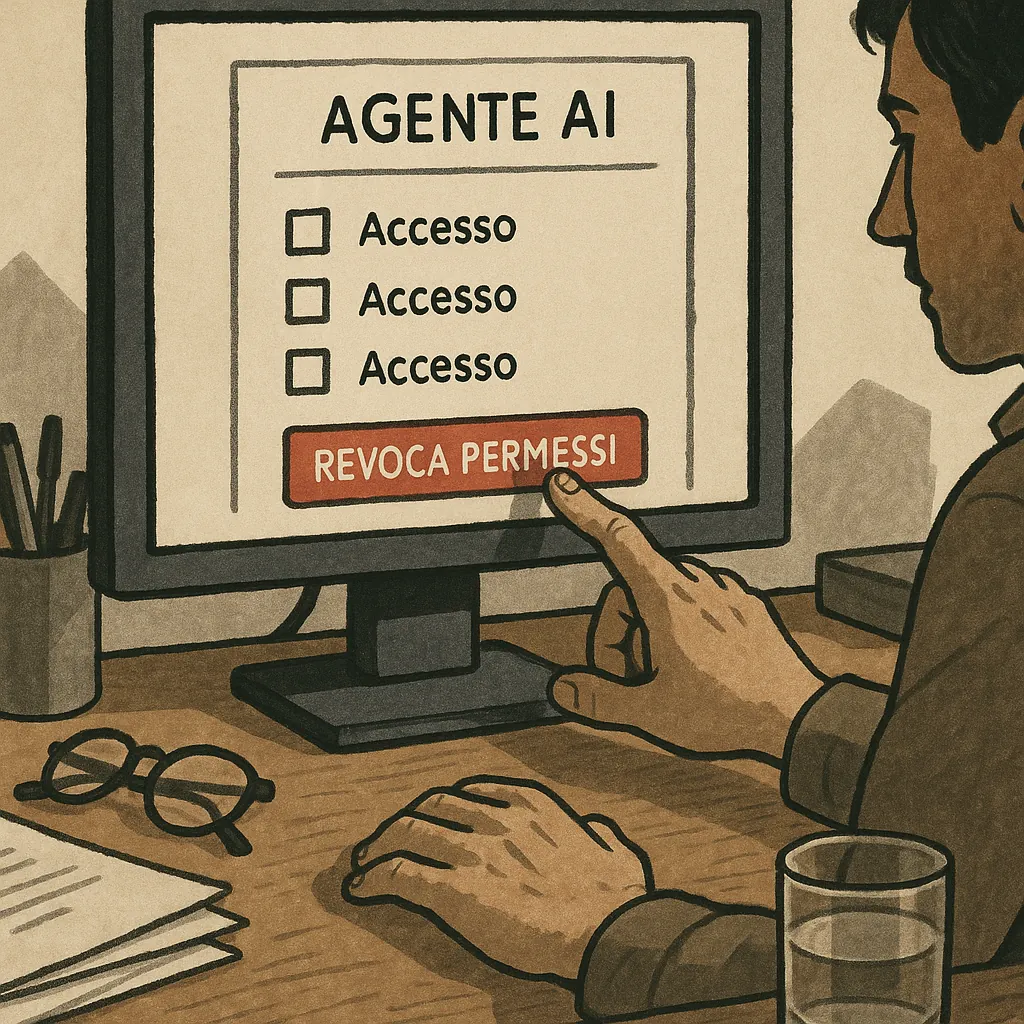
How to govern a non-human identity
The solution is to treat every AI agent as a real digital identity: least-privilege access, separate credentials, a log of every action and the ability to block access at once if there is a problem. In practice, you need an Identity and Access Management system that includes AI agents as well as people. That means always knowing who (or what) did what, when and with which permissions. An example: in a services SME that automates replies to customers, every agent has its own identity, with clear roles and limits, monitored in real time.
Governance and continuous monitoring
Creating the identities is not enough: they have to be monitored and updated over time. Every process change, every new agent, every change of permissions must be tracked. An effective system immediately flags anomalous logins or attempts at unauthorised actions. This approach makes it possible to extend automation without losing control of security. It is the difference between a system you can scale with confidence and one that becomes unmanageable after a few months.
What it is: Identity and Access Management for AI agents
It is the system that manages the digital identities of AI agents with human oversight, controls their permissions and tracks all their actions, ensuring security and governance for non-human identities too.
Frequently asked questions
Why does an AI agent's identity need to be managed?
Because every AI agent has its own credentials and permissions and can access sensitive data. Without control, the risk of errors or attacks grows.
Can an AI agent have the same permissions as a human?
No. Each agent should have only the permissions strictly necessary for its task, kept separate and revocable at any time.
How do you monitor what an AI agent does?
Through detailed logs of every action taken, notifications for anomalous logins and periodic reviews of the permissions assigned.
What happens if an AI agent is compromised?
An effective Identity and Access Management system lets you block access at once and analyse what happened, limiting the damage.
Drafts are produced by the Brainvision OS editorial pipeline and reviewed by a person before publication.
Keep reading
All articles
12 September 2026
AI agent security: how to prevent breaches in your company
How to avoid unauthorised access and security breaches with AI agents in SMEs. Concrete measures for compliance and data protection.

25 August 2026
AI agents and cybersecurity in critical infrastructure
How AI agents with human oversight strengthen the security of critical infrastructure against automated attacks in industrial settings.

16 August 2026
Digital identity: how to tell a human from a bot
How do you check whether an online user is really human? New authentication solutions for SMEs and digital services.